
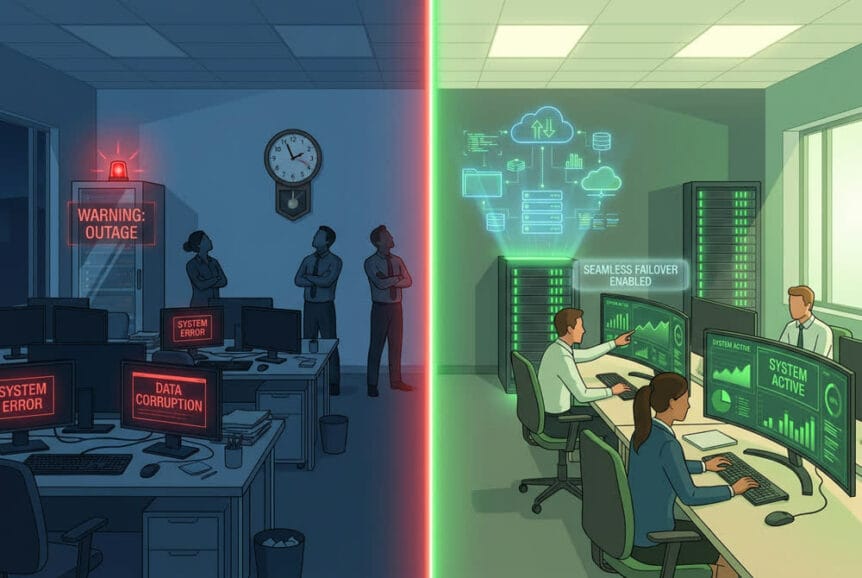
The Critical Gap Between Data Backup and Business Continuity
Most business owners believe their data backup system provides complete protection against disasters. This assumption creates a dangerous blind spot: while your data might be safely stored, your business operations can still grind to a halt for hours or even days during the recovery process.
The distinction between data recovery and operational continuity represents more than technical semantics. Recovery focuses on restoring your information after an incident occurs. Continuity ensures your business keeps functioning throughout the disruption. This gap between having backups and maintaining operations is where companies hemorrhage revenue, lose customers, and damage reputations built over years.
What Traditional Backup Really Protects (And What It Doesn’t)
Traditional backup solutions excel at one thing: preserving copies of your data. When ransomware encrypts your files or hardware fails, those backups provide the raw material needed for recovery. However, they don’t address the operational void that occurs while you’re waiting for systems to come back online.
Consider what happens during a typical restoration process. Your IT team must first identify the problem, sanitize affected systems, and then begin the sequential process of restoring data. Depending on how much information you’re recovering and the complexity of your infrastructure, this timeline can stretch from several hours to multiple days. During this entire period, your business operates in crisis mode or doesn’t operate at all.
The mathematics of this downtime are sobering. For small businesses, IT outages cost between $8,000 and $25,000 per hour. A seemingly brief eight-hour recovery translates to potential losses between $64,000 and $200,000. These figures represent only direct financial impact, they don’t account for the customers who couldn’t complete purchases, the clients who couldn’t reach your team, or the employees sitting idle while systems remain unavailable.
The True Cost of Downtime: Beyond Lost Data
Direct revenue loss represents just the visible portion of downtime costs. The hidden expenses often prove more devastating over time. Customer trust erodes with each hour your systems remain offline. When clients can’t access your services or complete transactions, they experience your unreliability firsthand. Research shows that 41% of customers detect downtime before companies even realize systems are down, amplifying frustration and diluting loyalty.
The long-term consequences extend far beyond the immediate incident. Studies indicate that 60% of small businesses close within six months following a major data loss event. Another sobering statistic: 72% of small businesses suffering a significant cyberattack cease operations within two years. These failures stem not just from lost data, but from the cumulative impact of extended downtime, damaged customer relationships, and depleted financial reserves.
Brand reputation damage from a significant outage can have lasting consequences, with 41% of companies facing permanent harm if they fail to respond within 48 hours, though organizations with established crisis management strategies recover significantly faster. Companies often spend substantial amounts on post-incident marketing just to rebuild customer confidence. For small and medium-sized businesses without large marketing budgets, this reputational damage can prove insurmountable.
Why Recovery Time Matters More Than You Think
Recent industry research reveals a concerning disconnect between business expectations and reality. While more than 60% of companies believe they can restore operations within 24 hours, only 35% actually achieve this target during real incidents. This performance gap stems from underestimating restoration complexity.
Real-world recovery involves multiple phases: detecting the problem, making decisions about response strategies, executing the restoration process, and testing systems before bringing them back into production. Each phase takes time, and complications frequently arise. A backup that worked perfectly in testing might encounter issues with current system configurations. Data corruption might not become apparent until midway through restoration. Dependencies between systems might not be fully documented.
For South Florida businesses, additional challenges compound these issues. Hurricane season brings the threat of extended power outages and physical infrastructure damage. When your primary systems and backup hardware reside in the same facility, a single weather event can compromise both simultaneously. This scenario transforms a manageable recovery into a catastrophic failure.
Calculating Your Business’s Vulnerability to Operational Disruption
Understanding your specific vulnerability requires examining two critical metrics: Recovery Time Objective (RTO) and Recovery Point Objective (RPO). RTO represents the maximum acceptable downtime before significant business harm occurs. RPO defines how much data you can afford to lose, measured as the time between your last backup and the disruption.
These aren’t abstract technical specifications. They translate directly into business impact. If your RTO is four hours but your actual recovery takes eight, you’ve exceeded your tolerance threshold. If your RPO is one hour but you only back up daily, you could lose up to 24 hours of work during an incident occurring just before your next scheduled backup.
Quantifying Your Hourly Revenue at Risk
Calculating your downtime exposure starts with a straightforward formula: multiply your average hourly revenue by the number of hours you’d be offline, then add the cost of idle employees and recovery efforts. A company with 25 employees averaging $30 per hour in labor costs faces $750 in employee costs alone for each hour of downtime, before counting lost revenue or recovery expenses.
For businesses processing transactions, the calculation becomes more urgent. An e-commerce company generating $500 per hour in online sales loses that revenue directly during outages, plus faces the likelihood that customers will shop elsewhere rather than waiting for systems to return. Professional services firms might not lose immediate revenue, but they accumulate billable hours that can never be recovered and face potential contract penalties for missed deadlines.
The Ripple Effect: Long-Term Consequences of Extended Outages
Extended downtime creates cascading problems that persist long after systems come back online. Customer churn accelerates as frustrated clients seek more reliable alternatives. Word spreads through reviews and social media, deterring potential new customers. Existing contracts may include service level agreements with financial penalties for unavailability.
Employee morale suffers during and after major outages. Your team experiences the stress of crisis management, the frustration of being unable to serve customers, and the anxiety about business stability. This stress contributes to turnover, adding recruitment and training costs to your disaster recovery expenses.
Regulatory compliance adds another layer of complexity. Businesses handling sensitive data face potential fines if outages compromise data protection requirements. Healthcare practices must maintain HIPAA compliance, financial services must protect customer information, and many industries face sector-specific regulations that don’t pause during system failures.
Industry-Specific Downtime Impacts
Different industries face unique vulnerabilities during outages. Retail and e-commerce businesses lose every potential sale during downtime, with the impact multiplying during peak shopping periods. A system failure during the holiday season or a major sale event can eliminate the year’s most profitable revenue window.
Professional services firms face different but equally serious consequences. When attorneys, accountants, or consultants can’t access client files or communication systems, they miss deadlines and damage client relationships built over years. The inability to deliver services on schedule can trigger contract breaches and malpractice concerns.
Healthcare providers encounter life-safety issues during system outages. When electronic health records become unavailable, care quality suffers and patient safety risks increase. Medical practices also face substantial regulatory scrutiny following any incident affecting patient data or care delivery.
Modern Business Continuity Solutions That Keep You Running
Effective Business Continuity and Disaster Recovery (BCDR) solutions prioritize keeping operations running rather than simply preserving data for eventual restoration. These comprehensive strategies address the entire business impact of disruptions, not just the technical challenge of data recovery.
The key differentiator is failover capability. Instead of waiting hours or days for complete system restoration, modern BCDR solutions enable rapid transition to virtualized operations running from recent backup snapshots. This approach can restore functionality within minutes rather than hours, transforming potential disasters into manageable incidents.
Virtualization and Rapid Recovery Technologies
Cloud virtualization enables businesses to maintain operations during catastrophic server failures by abstracting applications and data from physical hardware. When your primary servers fail, virtual machines can spin up on alternative infrastructure almost immediately. This hardware independence means a failed server doesn’t equal a failed business.
The process works through continuous replication of your systems to virtual environments. These virtual machines capture complete system states, including operating systems, applications, configurations, and data. During a disaster, these VMs activate on secondary infrastructure, allowing employees to resume work while you address the primary system failure.
Geographic redundancy adds another protection layer. By replicating data across multiple data centers or regions, businesses ensure that localized disasters don’t compromise operations. When a hurricane threatens South Florida, your systems can failover to infrastructure in another region entirely, maintaining availability regardless of local conditions.
The Hybrid Cloud Advantage for Small Businesses
Hybrid cloud backup combines local recovery speed with cloud-based disaster resilience, providing the best of both approaches. Local backups enable rapid recovery for routine issues like accidental file deletions or minor system problems. Cloud backups protect against comprehensive infrastructure failures like building fires, floods, or ransomware that compromises local systems.
This dual-layer strategy delivers near-instantaneous recovery for common problems while maintaining robust protection against catastrophic events. When your local systems remain functional, recovery happens in minutes using on-site backups. When local infrastructure becomes compromised, clean copies remain accessible through cloud infrastructure, enabling continued operations from any location with internet access.
Cost-effectiveness makes hybrid approaches particularly valuable for small and medium-sized businesses. Rather than choosing between expensive high-availability systems and risky single-point backup solutions, hybrid strategies provide enterprise-level protection at manageable price points. You gain comprehensive protection without overinvesting in unlikely scenarios or underprotecting against common risks.
Automated Failover: Minimizing Human Error During Crises
Human error represents the leading cause of IT downtime across all industries. During crisis situations, stress and time pressure increase the likelihood of mistakes. Automated failover systems reduce this vulnerability by executing predetermined response procedures without requiring manual intervention.
When monitoring systems detect failures, automated processes can initiate failover to backup systems, notify appropriate personnel, and begin recovery procedures simultaneously. This automation eliminates the delays associated with problem detection, decision-making, and manual execution of recovery steps.
Automated systems also ensure consistency. Recovery procedures execute the same way every time, following documented best practices rather than relying on whoever happens to be available during an incident. This reliability proves especially valuable for small businesses without a dedicated 24/7 IT staff.
Building and Testing Your Business Continuity Plan
Creating an effective BCDR strategy requires more than purchasing backup software. You need a comprehensive plan that identifies critical systems, establishes recovery priorities, and ensures your team knows how to execute recovery procedures when needed.
Conducting a Business Impact Analysis
Business Impact Analysis (BIA) forms the foundation of effective continuity planning. This process identifies which systems and processes are most critical to your operations and quantifies the impact of their unavailability. Start by listing all business applications, databases, and services, then assess the operational and financial impact of losing each one.
Categorize systems into tiers based on their criticality. Tier 1 systems require the fastest recovery because they directly impact revenue or critical operations, though 2025 data shows that 70% of large enterprises still take 60 minutes or more to resolve outages, with average recovery times reaching 196 minutes. These might include point-of-sale systems, order processing applications, or customer communication platforms. Tier 2 systems can tolerate one to four hours of downtime without severe impact. Tier 3 systems can remain offline for four to 24 hours.
This tiered approach lets you allocate protection resources efficiently. You invest most heavily in protecting and rapidly recovering Tier 1 systems while accepting longer recovery times for less critical applications. This prioritization ensures your limited budget delivers maximum protection for operations that matter most.
Establishing Realistic Recovery Objectives
Setting appropriate RTO and RPO targets requires balancing business needs against budget constraints. Begin by determining the maximum tolerable downtime for each system tier. For Tier 1 systems, this might be 30 minutes. For Tier 3 systems, perhaps 24 hours is acceptable.
Next, calculate the cost of achieving these targets versus the cost of downtime. If a four-hour outage costs your business $40,000, spending $500 monthly on solutions that reduce potential downtime to one hour could save you $30,000 per incident—though actual downtime costs vary widely, with recent reports showing SMBs experiencing anywhere from $1,000 to $25,000 per hour depending on their size and industry. The investment prevents potential losses that can range from $10,000 to over $1,000,000 per incident, depending on your business size and industry, with average downtime costs reaching $9,000 per minute for many organizations.
RPO calculations follow similar logic. Determine how much data loss you can tolerate for each system. Transaction-heavy applications might require near-zero data loss, necessitating continuous replication. Other systems might tolerate losing several hours of work, allowing less frequent backups.
Testing and Maintenance Best Practices
Plans that aren’t tested regularly fail when you need them most. Schedule annual comprehensive tests of your entire BCDR strategy, with more frequent testing after significant infrastructure changes. Testing should progress from simple plan reviews to full-scale simulations of disaster scenarios.
Begin with tabletop exercises where your team walks through recovery procedures verbally, identifying gaps in documentation or unclear responsibilities. Progress to controlled simulations where you actually execute recovery procedures in test environments. Eventually, conduct full-scale drills that simulate real disasters and measure your ability to meet recovery objectives.
Document every test, noting what worked well and what needs improvement. Update your plan based on these findings, and retest problem areas. This continuous improvement cycle ensures your BCDR strategy evolves with your business, remaining effective as systems change and new threats emerge.
We help South Florida businesses develop, implement, and test comprehensive BCDR strategies tailored to their specific needs and budgets. Our approach ensures you maintain operations during disruptions while controlling costs and complexity. Contact us to assess your current vulnerabilities and develop protection strategies that keep your business running when others go dark.