
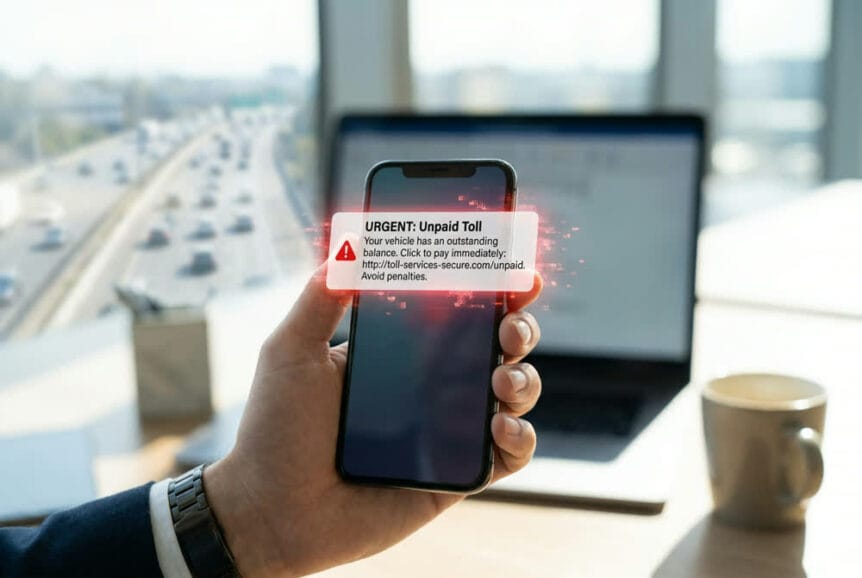
Your employees are receiving text messages that look completely legitimate. A notification about an unpaid toll from SunPass. A parking citation from the city. A traffic violation from the Florida DMV. The message includes official-sounding language, threatens penalties, and provides a convenient link to “resolve” the issue immediately.
These aren’t legitimate government communications. They’re part of a massive, coordinated fraud operation that cybersecurity researchers have been tracking since late 2025. The campaign has already deployed more than 79,000 fraudulent text messages across 12 countries, with the United States serving as the primary target market. South Florida businesses face particularly high exposure due to the region’s heavy toll road usage and the scammers’ focus on impersonating SunPass and the Florida DMV.
The Anatomy of Modern Smishing Operations
The sophistication of these attacks goes far beyond simple spam texts. Researchers have documented over 29,200 unique message variants, each carefully crafted to evade automated detection systems. The operation maintains more than 31,900 distinct malicious URLs, constantly rotating domains to stay ahead of security blacklists and anti-phishing technologies.
What makes this campaign particularly dangerous is its precision. These aren’t generic scam messages sent to random phone numbers. The fraudsters deploy multi-language campaigns in English, Spanish, Portuguese, French, and Hindi, targeting specific regions with localized content that references actual toll operators, parking authorities, and government agencies in each area.
In the United States alone, the campaign has generated over 25,000 phishing URLs across 17 distinct operations. California and Texas show the highest concentration of activity, but Florida remains a significant target due to widespread toll road infrastructure and the popularity of electronic toll collection systems like SunPass.
Why Traffic-Themed Scams Are So Effective
These scams exploit a universal anxiety that nearly every driver experiences: the fear of overlooking a traffic violation or unpaid toll. The psychological manipulation follows a consistent framework designed to trigger immediate action without careful consideration.
Recipients receive messages claiming unpaid tolls, traffic violations, or parking citations with artificially tight deadlines, typically 24 to 72 hours for resolution. The threats escalate quickly. A 35% late fee surcharge. License suspension. Vehicle registration restrictions. Legal action. In the most aggressive variants, the messages even mention arrest warrants.
The scammers understand that most people want to resolve these issues quickly to avoid complications. That urgency, combined with the apparent legitimacy of the message, creates the perfect conditions for victims to click malicious links and enter sensitive information without verification.
Regional Targeting and Localization Strategies
The Florida-focused campaigns demonstrate remarkable attention to detail. Scammers create fake websites that closely mirror the actual SunPass portal, complete with similar color schemes, logos, and navigation elements. They reference specific toll roads and use language patterns that match legitimate Florida Department of Highway Safety and Motor Vehicles communications.
Sample messages follow predictable patterns: “Florida Administrative Penalty Notice: You have an unpaid traffic ticket. An arrest warrant will be issued. Your vehicle registration will be suspended starting [date]. Pay: [malicious link].” The domains often incorporate official-sounding terms like “gov,” “dmv,” or “sunpass” in ways designed to appear legitimate at first glance.
The campaign extends beyond Florida. Scammers impersonate E-ZPass in northeastern states, FastTrak in California, and dozens of other regional toll operators. Each variant uses locally relevant terminology, payment amounts typical for that region, and threats appropriate to local traffic enforcement procedures.
Red Flags Every Employee Should Recognize
Training your team to identify these fraudulent messages requires understanding the specific warning signs that distinguish scams from legitimate communications. While the fake messages can appear convincing, they consistently exhibit certain characteristics that reveal their true nature.
Identifying Suspicious Sender Information
Legitimate toll authorities and government agencies rarely initiate payment demands via text message. When they do send account alerts, those messages come from verified, consistent sender numbers or short codes that customers can confirm through official channels.
SunPass, for example, uses the short code 786727 for legitimate text communications, and those messages never demand immediate payment through embedded links. The Florida DMV primarily communicates through postal mail for violation notices and uses official email addresses for electronic correspondence, not random phone numbers.
Scammers exploit technical vulnerabilities to make their messages appear more legitimate. They spoof sender IDs to make texts appear within existing conversation threads with real agencies. They use short codes that look official but aren’t registered to the agencies they’re impersonating. Some messages arrive from international numbers, email-to-SMS gateways, or constantly changing phone numbers that prevent easy blocking.
Recognizing Urgent Payment Demands and Threats
The artificial urgency in these messages serves as one of the most reliable indicators of fraud. Legitimate agencies provide reasonable timeframes for payment and multiple notice opportunities before escalating to serious consequences.
Pay attention to specific language patterns. The “35% late fee” appears consistently across multiple campaign variants, regardless of the agency being impersonated. Threats of immediate license suspension, arrest warrants, or vehicle registration holds without prior mailed notices don’t align with actual government procedures.
Real traffic enforcement follows documented processes. You receive mailed citations with case numbers, court information, and multiple payment options. Toll authorities send invoices to registered vehicle owners before escalating to penalties. Legitimate agencies don’t threaten arrest for unpaid tolls via text message.
Spotting Technical Red Flags in Message Content
The technical construction of these messages reveals their fraudulent nature to careful observers. Scammers use sophisticated evasion techniques, but these same techniques create detectable anomalies.
Examine URLs carefully. Legitimate government and toll operator websites use consistent, official domains. Fraudulent messages use domain names that incorporate official-sounding terms but host content on suspicious infrastructure. You might see “sunpass-payment.bond” or “fl-dmv-pay.site” instead of actual government domains.
Some campaigns use character substitution techniques, replacing Latin letters with visually similar Cyrillic characters to bypass text filtering systems. The message looks normal, but the underlying characters differ from standard English text. URL shorteners and obfuscated links hide the true destination, making it impossible to verify legitimacy before clicking.
Messages requesting “Reply Y” before links become active represent another technical red flag. This technique attempts to bypass iOS security features that block certain link types in unsolicited messages. Legitimate agencies never require activation responses before providing information.
Business Risk and Corporate Network Security Implications
When an employee falls victim to a traffic-themed SMS phishing attack on their personal or company-issued smartphone, the consequences extend far beyond that individual device. These compromises create pathways for attackers to access corporate networks, business data, and sensitive customer information.
Mobile Device Vulnerabilities in Corporate Environments
SMS phishing bypasses the security controls that protect your business email and network perimeter. Your email gateway filters don’t inspect text messages. Your endpoint protection software may not monitor SMS content. Traditional security awareness training often focuses on email phishing while neglecting the mobile attack surface.
Employees access corporate email, cloud applications, VPNs, and collaboration tools from their smartphones. When a smishing attack successfully harvests login credentials, attackers gain those same access capabilities. The compromised employee might have access to customer databases, financial systems, proprietary documents, or administrative tools that become available to the attacker.
The smaller screens on mobile devices make suspicious links harder to inspect. Users respond faster to text messages than emails, often acting before thinking critically about the content. These behavioral factors combine with technical limitations to create an environment where smishing attacks succeed at higher rates than comparable email phishing attempts.
Android Malware and Banking Credential Theft
Some traffic-themed SMS campaigns, particularly those targeting users in certain regions, go beyond simple credential harvesting to deploy sophisticated Android malware. These malicious applications, delivered through fake toll or parking payment apps, establish persistent access to victim devices and implement comprehensive data collection capabilities.
The malware requests permissions that seem reasonable for a payment application: SMS access, notification access, and accessibility services. Once granted, these permissions allow the malware to intercept banking alerts, capture one-time password codes, and steal login credentials entered into legitimate banking applications.
The technical implementation uses overlay attacks that display fake login screens on top of real banking apps. When an employee opens their bank’s legitimate application, the malware detects this action and presents a convincing replica of the login interface. Credentials entered into this fake overlay go directly to the attackers while the user believes they’re interacting with their actual banking app.
The malware maintains communication with attacker-controlled infrastructure through dual channels: Telegram bots for real-time data exfiltration and Firebase for remote command and control. This architecture transforms infected devices into remotely controlled assets that attackers can manipulate for ongoing fraud operations.
The Path from Personal Device to Corporate Data Breach
Consider how a simple traffic-themed SMS scam targeting an employee’s personal phone could escalate into a significant business security incident. The employee receives a text about an unpaid SunPass toll, clicks the link, and enters their credit card information on a fraudulent payment page.
The fake payment form also requests email and password for “account verification.” The employee, already committed to resolving the supposed toll violation, provides their work email credentials. The attackers now have access to corporate email, where they find information about business processes, customer lists, vendor relationships, and internal communications.
From the compromised email account, attackers can reset passwords for other business systems, send convincing phishing emails to coworkers and customers, access cloud storage containing sensitive documents, or identify high-value targets for more sophisticated attacks. If the employee has elevated privileges or access to financial systems, the potential damage multiplies.
This scenario isn’t theoretical. The FBI’s Internet Crime Complaint Center received 59,271 complaints about toll-related smishing scams in 2024 alone. The Federal Trade Commission reports that text-based scam losses reached $470 million in 2024, representing a five-fold increase from 2020 levels. Your business and employees face real, documented threats that require proactive defense strategies.
Protection Strategies and Response Procedures
Defending your organization against traffic-themed SMS phishing requires a multi-layered approach combining technical controls, policy development, and employee education. No single solution provides complete protection; effective defense demands comprehensive strategy implementation.
Mobile Device Management and Security Solutions
We recommend implementing Mobile Device Management (MDM) solutions that provide visibility and control over devices accessing corporate resources. The strongest platforms for smishing protection include Microsoft Intune, particularly for organizations already using Microsoft 365, IBM MaaS360 for enterprise-scale security needs, and Sophos Mobile for businesses prioritizing anti-phishing capabilities.
Effective MDM deployment should include conditional access policies that prevent compromised or non-compliant devices from accessing sensitive business data. Application control features limit which messaging and communication apps employees can use on devices with corporate access. Remote wipe capabilities protect business data when devices are lost, stolen, or compromised.
For organizations with bring-your-own-device (BYOD) policies, containerization separates corporate data from personal information on employee smartphones. This approach protects business assets without requiring invasive monitoring of personal device usage.
Employee Training and Awareness Programs
Your employees represent both your greatest vulnerability and your strongest defense against SMS phishing attacks. Regular training programs should cover specific recognition techniques for traffic-themed scams, including the warning signs we’ve outlined in this article.
Training should emphasize the verification procedure: never click links in unexpected text messages claiming unpaid tolls or traffic violations. Instead, employees should independently navigate to official websites using known, verified URLs or contact agencies using official phone numbers found through independent research.
Create clear policies about reporting suspicious messages. Employees need to know they won’t face negative consequences for reporting potential scams, even if they initially clicked a link or provided information. Quick reporting enables your IT team to assess potential compromise and implement protective measures before attackers can exploit access.
Incident Reporting and Response Protocols
When an employee receives a suspected smishing message or believes they may have fallen victim to a scam, immediate action following proper procedures minimizes potential damage.
- Stop all interaction with the message. Don’t click additional links, reply to the message, or provide any further information.
- Preserve evidence by taking screenshots that capture the sender information, message content, and any URLs included in the text.
- Report the message to the wireless carrier by forwarding it to 7726 (SPAM), which helps carriers identify and block similar messages.
- Notify your IT department immediately if the message was received on a company device or if any corporate credentials were potentially compromised.
- File complaints with appropriate authorities, including the FCC for smishing attempts and the FBI’s Internet Crime Complaint Center (IC3.gov) if the scam involved fraud or resulted in financial loss.
- If banking information or personal credentials were provided, contact financial institutions immediately to monitor for unauthorized activity and implement additional security measures.
Your IT team should have documented response procedures for potential mobile device compromise, including credential resets, access reviews, and security assessments to determine whether attackers gained access to corporate systems.
Traffic-themed SMS phishing represents a sophisticated, well-funded threat that continues to evolve and expand. The combination of psychological manipulation, technical evasion, and widespread targeting makes these campaigns dangerous to businesses of all sizes. By understanding the threat, training your employees, implementing appropriate technical controls, and maintaining clear response procedures, you can significantly reduce your organization’s risk exposure.
We work with South Florida businesses every day to implement comprehensive mobile security strategies that protect against smishing and other emerging threats. If you have questions about securing your organization’s mobile devices or need assistance evaluating MDM solutions, our team is ready to help you develop a protection strategy appropriate for your specific business needs and risk profile.