
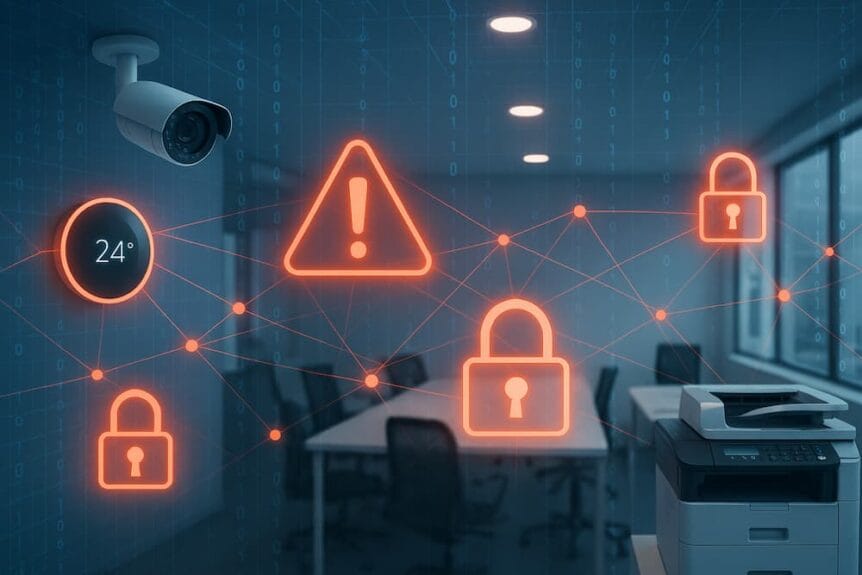
Walk into any modern office and you’ll find dozens of connected devices quietly humming away: smart thermostats adjusting the temperature, security cameras monitoring entry points, intelligent lighting systems responding to occupancy, and networked printers handling sensitive documents. These Internet of Things (IoT) devices have become essential business tools, streamlining operations and cutting costs. However, they’ve also created new pathways for cybercriminals to infiltrate company networks.
The security vulnerabilities targeting workplace IoT devices are both varied and concerning. Weak authentication remains one of the most exploited weaknesses, with many devices shipped using default credentials that are publicly documented and easily discoverable. Attackers regularly scan networks looking for devices still using factory passwords, and once inside, they can move laterally across your infrastructure. Man-in-the-middle attacks allow hackers to intercept communications between devices and their management systems, potentially capturing sensitive data or injecting malicious commands. Unencrypted data transmission makes this interception even easier.
Real-world breaches demonstrate these aren’t theoretical concerns. Attackers have compromised office security camera systems to scout building layouts before physical break-ins. Smart HVAC systems have served as entry points for ransomware attacks that locked entire companies out of their networks. In one notable case, a casino’s high-roller database was accessed through a compromised smart thermometer in a lobby aquarium. These incidents highlight how seemingly innocuous devices can become serious security liabilities.
The financial and operational consequences extend far beyond the initial breach. Companies face regulatory fines for data exposure, particularly when customer or employee information is compromised. Business interruption costs mount quickly when systems go offline. Reputation damage can persist for years, affecting client relationships and competitive positioning. For small and medium businesses, a significant breach can threaten viability.
Understanding Your Business’s Attack Surface
Your company’s attack surface includes every connected device on your network. Security cameras and video doorbells monitor your premises but also stream potentially sensitive footage to cloud servers. Smart thermostats and building management systems control physical environments while collecting occupancy patterns and usage data. Access control systems manage who enters your facility but also maintain detailed logs of employee movements. Even networked printers, often overlooked in security planning, store copies of printed documents and maintain their own network connections.
The critical risk lies in how these devices interconnect. A compromised smart light bulb might seem harmless, but if it shares a network with your file servers and accounting systems, it becomes a stepping stone. Attackers exploit the weakest link, using it to map your network, identify valuable targets, and escalate privileges. One vulnerable device can expose your entire digital infrastructure.
The security gap between consumer and enterprise-grade devices matters significantly for businesses. Consumer devices prioritize ease of use and low cost, often sacrificing security features and long-term support. They may lack robust encryption, offer limited access controls, and receive infrequent security updates. Enterprise-grade alternatives typically include stronger authentication mechanisms, regular firmware updates, detailed logging capabilities, and vendor support commitments. While more expensive upfront, they provide security features proportional to business risk.
Data Privacy Risks in Business Settings
Smart devices in business environments collect surprisingly detailed information. Security cameras capture not just video but also audio, facial recognition data, and behavioral patterns. Access control systems log employee arrival and departure times, movement between spaces, and failed access attempts. Smart conference room systems may record meeting audio or track participant engagement. Even environmental sensors gathering temperature and occupancy data can reveal business operations, staffing levels, and usage patterns.
This data collection creates compliance obligations that vary by industry and jurisdiction. Healthcare organizations face HIPAA requirements for any device that might capture patient information, including cameras in waiting areas or smart building systems in treatment facilities. Financial services firms must consider how device data intersects with customer privacy regulations. Companies operating in Europe or serving European customers must evaluate GDPR implications for any personal data collection. State-level privacy laws add additional layers of compliance complexity.
Third-party data sharing complicates the picture further. Many smart device manufacturers transmit collected data to cloud platforms for processing and storage. These platforms may share information with analytics partners, advertising networks, or other third parties. Your vendor agreements should clearly specify data handling practices, but many standard terms of service grant broad permissions that conflict with business privacy obligations. Effective vendor management requires understanding not just what your devices collect, but where that data goes and who can access it.
Strategic Device Selection for Business Security
Before purchasing any smart device for business use, conduct a structured risk-benefit analysis. Define the specific business problem you’re solving and quantify expected benefits. Then evaluate the security risks introduced, including potential data exposure, network vulnerabilities, and compliance implications. Consider whether a non-connected alternative could meet your needs with less risk. A traditional programmable thermostat might serve adequately if remote management isn’t essential. Sometimes the most secure device is the one that stays offline.
When smart connectivity genuinely adds business value, prioritize devices with specific security features built in from design. Look for products supporting strong encryption protocols for both data transmission and storage. Verify that devices allow custom administrative credentials and never purchase products with unchangeable passwords. Confirm the availability of regular firmware updates with a clear update mechanism. Devices should support network segmentation, allowing isolation from critical business systems. Multi-factor authentication capability adds crucial protection for device management interfaces.
Manufacturer reputation deserves careful evaluation. Research the company’s security track record and history of addressing vulnerabilities. Review how quickly they’ve responded to past security issues and whether they maintain transparent communication about risks. Examine their support commitments, particularly regarding update timelines and end-of-life policies. A manufacturer committed to security will clearly document these practices and stand behind their products with meaningful support agreements.
Industry Standards and Certifications to Look For
Security certifications provide objective validation that devices meet established standards. ETSI EN 303 645 represents a comprehensive baseline for IoT security, encompassing thirteen key requirements including prohibition of default passwords, implementation of vulnerability disclosure policies, and secure software updates. Originally European, this standard has gained international adoption and forms the foundation for many national certification schemes. Devices compliant with ETSI EN 303 645 demonstrate adherence to recognized security fundamentals.
PSA Certified offers a multi-level security assurance program developed specifically for IoT devices. It evaluates hardware security, software protection, and device lifecycle management across three progressive certification levels. This allows businesses to select devices with security assurance appropriate to their risk tolerance and use case. UL IoT Security Certification provides globally recognized validation through rigorous testing and ongoing compliance requirements. CTIA IoT Cybersecurity Certification focuses specifically on data privacy and threat resistance capabilities.
The U.S. Cyber Trust Mark, a newer initiative, requires devices to implement strong authentication, maintain regular security updates, and demonstrate effective vulnerability management aligned with NIST cybersecurity frameworks. ISO/IEC 27400:2022 provides comprehensive international standards covering both cyber and physical security dimensions. For businesses concerned about cryptographic security, FIPS 140-3 certification validates hardware-based encryption implementations.
These certifications matter beyond technical security. They demonstrate due diligence in vendor selection, which can be relevant for liability considerations if a breach occurs. Insurance carriers increasingly consider security practices when underwriting cyber insurance policies, and certified devices may favorably influence coverage terms. Regulatory audits benefit from documented use of certified equipment meeting recognized standards.
Vendor Due Diligence and Privacy Policy Review
Thorough vendor evaluation should include direct questioning about security and data handling practices. Ask vendors to specify exactly what data their devices collect, how frequently it’s transmitted, and where it’s stored geographically. Request details about encryption methods used for data in transit and at rest. Inquire about their vulnerability disclosure process and average time to patch critical security issues. Question whether they share data with third parties and under what circumstances.
Privacy policies and terms of service require close reading despite their length. Look for red flags including vague language about data usage rights, overly broad permissions to share information, unclear retention periods, or terms allowing unilateral policy changes without notice. Pay attention to provisions about data ownership and your rights to access, export, or delete collected information. Terms that heavily favor the vendor or limit their liability for security incidents deserve scrutiny and potentially negotiation.
Establish clear contractual requirements for data handling aligned with your business needs and compliance obligations. Specify maximum data retention periods and require deletion upon request or contract termination. Define acceptable use limitations preventing vendors from repurposing your data. Include provisions for security incident notification, specifying timeframes and required information. For sensitive business applications, consider requiring third-party security audits and the right to review results.
Implementation Best Practices for Business Networks
Network segmentation stands as one of the most effective protective measures for smart device deployment. By isolating IoT devices from your core business network, you contain potential breaches and prevent compromised devices from accessing sensitive systems. Implementation can range from simple to sophisticated depending on your infrastructure and risk tolerance.
Creating separate VLANs (Virtual Local Area Networks) provides robust logical separation while using the same physical network infrastructure. Configure your managed switches to assign IoT devices to a dedicated VLAN with restricted access to other network segments. Define firewall rules controlling exactly what communication is permitted between the IoT VLAN and other networks. Many businesses create multiple VLANs, separating devices by function or security sensitivity. Guest network features on business-grade routers offer a simpler alternative, establishing an isolated wireless network for smart devices with no access to your primary network resources.
Implement proper access controls governing both device management and network permissions. Limit which employees can configure or access smart devices based on job responsibilities. Use your firewall to restrict IoT devices to only the external services they require, blocking unnecessary internet access. Monitor traffic patterns from the IoT network segment, establishing baselines for normal behavior and alerting on anomalies. Consider implementing network access control (NAC) systems that authenticate devices before allowing network connection.
Authentication and Access Management
Default credentials represent one of the easiest attack vectors and must be eliminated completely across your device ecosystem. Before connecting any new device to your network, access its management interface and change both the username and password. Many devices allow username customization, which adds protection since attackers can’t assume standard administrator account names. If a device doesn’t permit credential changes, return it. The security risk is unacceptable for business environments.
Multi-factor authentication (MFA) should be implemented wherever devices or management platforms support it. MFA requires attackers to compromise multiple authentication factors rather than just a password, dramatically reducing successful breach attempts. Most enterprise-grade device management platforms now offer MFA options. Enable them universally and consider making MFA mandatory in your security policies.
Strong password policies specifically for device management deserve formal documentation and enforcement. Passwords should be lengthy (minimum sixteen characters for business systems), complex, and unique to each device or system. Avoid password reuse across devices, as a single compromise then affects multiple systems. Establish regular password rotation schedules, particularly for devices accessible from the internet or managed by multiple staff members.
Enterprise password managers solve the challenge of maintaining numerous complex passwords across many devices. These tools securely store credentials, generate random passwords meeting your policy requirements, and can enforce access controls determining which staff members can access specific device credentials. They also facilitate password rotation and provide audit trails of credential access. Choose password managers designed for team use with appropriate administrative controls and security features.
Encryption and Communication Security
Data encryption protects information both as it travels across networks and while stored on devices or servers. Verify that devices encrypt data transmission using current protocols like TLS 1.2 or higher. Avoid devices using outdated or proprietary encryption schemes that may contain vulnerabilities. For data storage, confirm that sensitive information is encrypted at rest, meaning it remains protected even if physical hardware is compromised.
Wi-Fi security configuration significantly impacts your smart device ecosystem. Configure all wireless networks using WPA3 encryption, the current strongest standard for Wi-Fi security. WPA3 provides enhanced protection against password guessing attacks and secures data even on open networks. For devices that don’t support WPA3, WPA2 with a strong password provides baseline protection, though these devices should be prioritized for replacement. Never operate business networks using WEP or open Wi-Fi, as these provide inadequate security.
VPN considerations become relevant when managing devices remotely or connecting devices across multiple locations. Rather than exposing device management interfaces directly to the internet, implement VPN access requiring authentication before reaching your network. This adds a security layer and encrypts all management traffic. For distributed deployments with smart devices at multiple sites, site-to-site VPNs can securely interconnect locations while maintaining encryption.
Ongoing Security Management and Maintenance
Firmware updates patch security vulnerabilities and must be applied systematically. Establish a clear schedule for checking and installing updates, with frequency based on device risk and manufacturer release patterns. Critical security infrastructure like access controls and cameras warrant monthly update checks at minimum. Less sensitive devices might be reviewed quarterly. Document your update schedule and assign responsibility for execution.
The choice between automated and manual updates involves tradeoffs. Automated updates ensure timely patching without relying on staff action, reducing the window of vulnerability. However, they introduce risk of updates causing operational disruptions during business hours or creating compatibility issues. For business environments, consider a hybrid approach: enable automatic updates for consumer-grade devices with limited business impact, but manually control updates for critical systems after testing in a non-production environment. Schedule manual updates during maintenance windows when disruptions can be managed.
Device lifecycle management policies should address the full spectrum from purchase through disposal. Define evaluation criteria for new device purchases incorporating security requirements. Establish tracking systems maintaining inventory of all smart devices, including purchase dates, firmware versions, and support status. Plan proactive replacement before devices reach end-of-life, as unsupported devices pose escalating security risks. Disposal procedures must ensure data is wiped and devices are physically destroyed or securely recycled to prevent information recovery.
Monitoring and Incident Response
Network monitoring provides visibility into device behavior and early warning of compromises. Deploy monitoring tools that track traffic patterns from your IoT network segments, establishing baselines for normal operation. Configure alerts for suspicious activities like unusual data volumes, connections to unexpected external addresses, or access attempts from unauthorized sources. Monitor authentication logs for repeated failed login attempts suggesting brute-force attacks.
Incident response procedures specific to smart devices should be documented and practiced. Define what constitutes a security incident requiring response, from suspected compromises to confirmed breaches. Establish clear escalation paths and notification requirements. Document containment steps like network isolation of affected devices or entire segments. Plan for evidence preservation if forensic analysis becomes necessary. Include communication protocols for notifying affected parties if data exposure occurs.
Regular security audits and vulnerability assessments keep your security posture current. Conduct quarterly reviews of device configurations, verifying that security settings remain properly configured. Perform annual penetration testing that specifically targets your IoT infrastructure, identifying exploitable vulnerabilities before attackers find them. Engage third-party security firms periodically for objective assessment of your smart device security program.
Employee Training and Awareness
Staff education forms a critical security layer that technology alone cannot provide. Employees need to understand how smart devices create security risks and their role in maintaining protection. Training should cover recognizing suspicious device behavior, the importance of reporting connectivity issues or unusual activity, and basic security hygiene like never sharing device credentials.
Personal device policies require clear definition and communication. Many employees want to connect personal smart devices to business networks for convenience. Establish explicit policies governing whether this is permitted and under what conditions. If allowed, personal devices should connect only to isolated guest networks, never to production business networks. Make clear that business IT departments cannot support personal devices and that owners accept full responsibility for any security issues they introduce.
Reporting procedures for security concerns should be simple and encourage proactive communication. Employees should know exactly who to contact if they observe unusual device behavior, receive suspicious configuration requests, or discover a device with default credentials. Create a culture where security questions are welcomed rather than dismissed, and acknowledge employees who identify potential issues.
Future-Proofing Your Smart Device Security Strategy
Planning device end-of-life and replacement cycles prevents security debt accumulation. Track manufacturer support commitments when purchasing devices, noting when security updates will cease. Create a replacement budget and timeline ensuring devices are upgraded before support ends. Unsupported devices should be removed from your network entirely, as they become increasingly vulnerable with no patches available for newly discovered vulnerabilities.
Staying informed about emerging threats and evolving standards requires ongoing attention. Subscribe to security bulletins from manufacturers of your deployed devices. Follow industry security organizations like CISA and NIST that publish threat intelligence and guidance. Participate in industry associations where peers share experiences and best practices. Dedicate time quarterly to review emerging smart device security trends and evaluate their relevance to your environment.
Building relationships with trusted IT security partners provides expertise that most businesses cannot maintain in-house. Managed service providers specializing in business IT security can monitor your environment, manage updates, conduct assessments, and respond to incidents. They bring experience across many client environments, providing perspective on effective security approaches and emerging threats. For businesses without dedicated IT security staff, these partnerships make comprehensive smart device security achievable.
Creating scalable security frameworks supports business growth without compromising protection. Document your security standards, procedures, and configurations so they can be consistently applied as you add locations or expand device deployments. Implement centralized management platforms that can accommodate growth. Design network architectures with expansion in mind, ensuring that security segmentation and monitoring can scale. Review and update your security program annually, incorporating lessons learned and adapting to your evolving business needs.
Smart device security for businesses isn’t a one-time project but an ongoing commitment. The connected technologies transforming business operations demand proportional attention to security. By selecting devices carefully, implementing them properly, and maintaining vigilant oversight, you can harness the benefits of smart technology while protecting your company from the very real risks these devices introduce. Your business’s security posture will be stronger, your compliance obligations better met, and your operational resilience enhanced.